
Upload images to this post to show gallery.
Gi halom i historia, manggaige un patlinan kalan amot, ni’ mañåsaga gi korason i tåno’ Indonesia. Este i patlinan remåka siha – pala, bunga pala, cengkeh, yan kayu manis – ni’ ti apmana umu’usa i mundo, ti para i na’e ha’ lao lokkue’ para amot yan i tåhlong. Ginen i manalak na attelong gi Maluku, i islan remåka, måtto i manggaige na balor siha ni’ fumana’gue i tinituhon global na komesio. Para håmi, i manasaga gi islas Pasifiku, i sasalåguan remåka gi Indonesia ha na’gåsgas i espiritu yan ha na’sinåhi i estoriå-ta siha. Tåya’ mas takhilo’ na istoria kinu i historia yanu’ remåka, ni’ ha na’la’la’ i interu na mundo, yan i isla siha gi Indonesia kumåti i korason este na biahe.
I historia remåka siha gi Indonesia, lalo’ gi Maluku, ha kumåti i mina’åse’ na chine’chule’ para i manhålom na mana’lå’la’. Ginen i Siglo XV, i manma’gas na nasion siha gi Europa manma’didi’i’ para i mannu’ na taotao ni’ ha tungo’ nai sumåsaga i manma’fåtto’ remåka siha. I sejarah jalur rempah, pat i historia yanu’ remåka, ha na’gaige i manma’å’ñao na biahe siha gi tasi ni’ ha na’tufok i komesio ginen Asia asta Europa. I historia remåka siha gi Indonesia ha pumu’etde i lina’la’ i isla siha, yan ha na’huyong na guma’i’ i isla siha gi Pasifiku, ni’ manå’nås i manma’gas na nasion siha. Este i rena’on remåka (pusaka rempah) ni’ manma’pipi’i na sinangan, ni’ ti para i na’e ha’ lao para i kultura, amot, yan i ekonomia.
I manma’gas na remåka, pala (nutmeg) yan bunga pala (mace), mana’mågåhet na ginen i islan Banda gi Maluku, Indonesia. I cengkeh (cloves) lokkue’ ginen Maluku, yan i kayu manis (cinnamon) ginen i islan Sumatra yan Java. Este siha i manma’chålek na remåka ni’ umu’usa i global na tasi, ni’ ha na’taotao i manma’gas na taotao, yan ha na’sina’an i manma’gas na isla siha.
I pala, pat nutmeg, un remåka ni’ ti apmana malago’ i mundo. Ginen i siña’ña’ na un tasi, i bunita na pala ha na’gåsgas i korason yan i hinasson. I isa pala (is a nutmeg) ti un håyu ha’ ni’ un chininan na’lå’la’ ni’ ha na’gåsgas i na’e, lao lokkue’ ha na’gaige un mina’åse’ na amot. I dinigå-ña ha na’fanhalom i hinasson i taotao gi minahgong yan i ginåsgas.
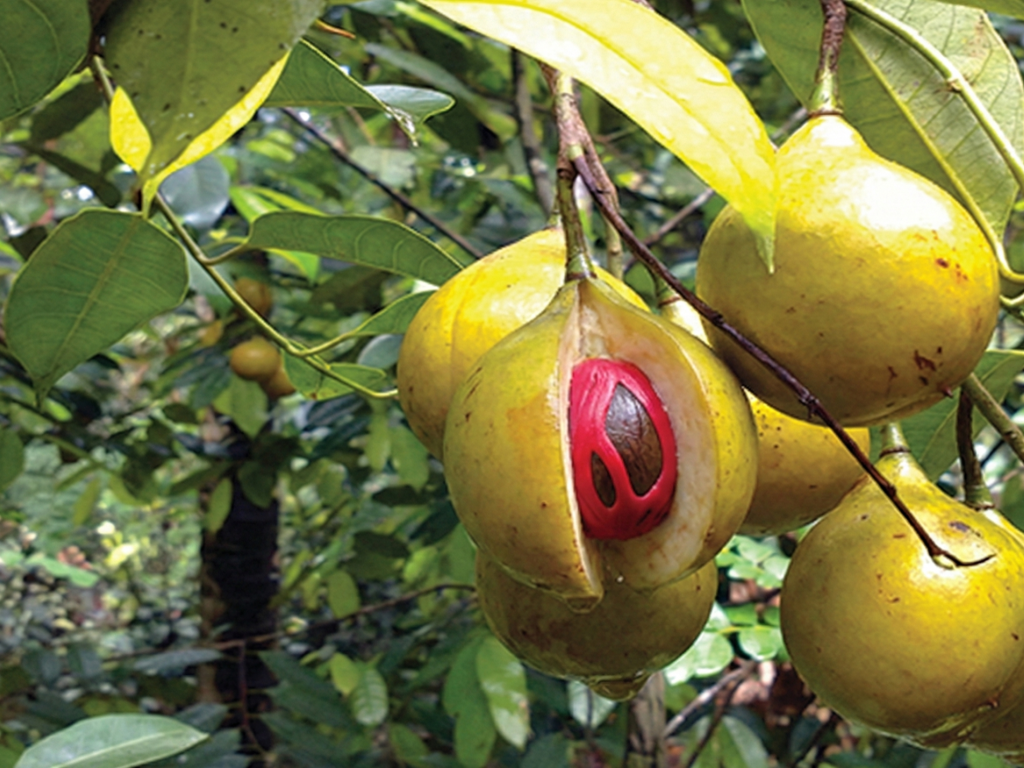
I pala na fruita guaha dos klasen remåka gi un ha’ fruita: i bija (seed) ni’ pala, yan i aril ni’ ma’ñåga gi bijan, i bunga pala (mace). I dinigå-ña i espisia pala, pat múskat krydd, ha na’gåsgas i manma’få’gasi’ na na’e, amot, yan i manggaige na na’lå’la’ gi ha’åni. Gi kusina, i pala ha na’gåsgas i sopas, i na’e, i desserts, yan i minagåhet na minagåhet gi kabales na na’e.
Lao i pala guaha lokkue’ amot na balot-ña. Guaha un compound na Myristicin gi pala. Myristicin (מיריסטיצין) un natural na compound ni’ guaha gi pala, ni’ ha na’gaige un minahgong yan minahgong na efekto gi taotao, lao debi di umu’usa gi dikike’ na kantidåt. Guaha lokkue’ anti-inflammatory properties-ña yan antioxidants ni’ ha na’gåsgas i salud. Lao ti debi di umu’usa gi dangkulo’ na kantidåt, sa’ guaha peligron-ña.

I bunga pala, pat mace, i måfino’ na bagian i fruita pala, ni’ ha na’gåsgas un mas dikike’ na dinigå kinu i pala. Este i dikike’ na plåtan i bijan, ni’ ha na’gåsgas un mas dikike’ na dinigå, lao mas complejo yan mas kinilo’. I bunga pala ha na’gåsgas i na’e, i sopas, yan i desserts, yan ha na’gåsgas i minahgong gi na’e siha.
Gi komesio internasionat, i mace HPS (High Purity/Selected) un standard para i kvalidåt. Este ha na’gåsgas na i bunga pala gaige gi mas takhilo’ na kvalidåt, sin contamination, yan måfino’ gi magåhet na dinigå. I mace HPS un na’magåhet na i produktun ma’cho’gue gi mina’åse’ yan ha na’gåsgas i mas takhilo’ na standard. I bunga pala ginen Indonesia ha na’gåsgas este na kvalidåt, ni’ ha na’gåsgas i manma’gas na komprås gi interu na mundo. I bunga pala un espisia gi (spices in) sopas, na’e, yan desserts, lalo’ gi i manma’få’gasi’ na na’e.

I cengkeh, pat cloves, i manma’gas na remåka ni’ ginen i manma’lå’la’ na tasi gi Maluku. I dinigå-ña ha na’gåsgas i mana’lå’la’ na minagåhet gi na’e, amot, yan i manma’lå’la’ na manma’lå’la’. I cengkeh ha na’gåsgas i hinasson i taotao gi minahgong yan i ginåsgas, yan ha na’gåsgas i hinasson i taotao gi minahgong yan i ginåsgas.
I cengkeh, ni’ ha na’gåsgas i bunita na forma-ña, guaha un natural na compound na Eugenol, ni’ ha na’gaige un mina’åse’ na amot. I Eugenol guaha anti-inflammatory, anti-oxidant, yan antiseptic properties-ña. I manma’gas na taotao manumu’usa i cengkeh para i nina’gasgas i nina’gasgas i nina’gasgas i nina’gasgas i nina’gasgas i nina’gasgas i nina’gasgas i nina’gasgas i nina’gasgas i nina’gasgas i nina’gasgas i nina’gasgas i nina’gasgas i nina’gasgas i nina’gasgas i nina’gasgas i nina’gasgas i nina’gasgas i nina’gasgas i nina’gasgas i nina’gasgas i nina’gasgas i nina’gasgas i nina’gasgas i nina’gasgas i nina’gasgas i nina’gasgas i nina’gasgas i nina’gasgas i nina’gasgas i nina’gasgas i nina’gasgas i nina’gasgas i nina’gasgas i nina’gasgas i nina’gasgas i nina’gasgas i nina’gasgas i nina’gasgas i nina’gasgas i nina’gasgas i nina’gasgas i nina’gasgas i nina’gasgas i nina’gasgas i nina’gasgas i nina’gasgas i nina’gasgas i nina’gasgas i nina’gasgas i nina’gasgas i nina’gasgas i nina’gasgas i nina’gasgas i nina’gasgas i nina’gasgas i nina’gasgas i nina’gasgas i nina’gasgas i nina’gasgas i nina’gasgas i nina’gasgas i nina’gasgas i nina’gasgas i nina’gasgas i nina’gasgas i nina’gasgas i nina’gasgas i nina’gasgas i nina’gasgas i nina’gasgas i nina’gasgas i nina’gasgas i nina’gasgas i nina’gasgas i nina’gasgas i nina’gasgas i nina’gasgas i nina’gasgas i nina’gasgas i nina’gasgas i nina’gasgas i nina’gasgas i nina’gasgas i nina’gasgas i nina’gasgas i nina’gasgas i nina’gasgas i nina’gasgas i nina’gasgas i nina’gasgas i nina’gasgas i nina’gasgas i nina’gasgas i nina’gasgas i nina’gasgas i nina’gasgas i nina’gasgas i nina’gasgas i nina’gasgas i nina’gasgas i nina’gasgas i nina’gasgas i nina’gasgas i nina’gasgas i nina’gasgas i nina’gasgas i nina’gasgas i nina’gasgas i nina’gasgas i nina’gasgas i nina’gasgas i nina’gasgas i nina’gasgas i nina’gasgas i nina’gasgas i nina’gasgas i nina’gasgas i nina’gasgas i nina’gasgas i nina’gasgas i nina’gasgas i nina’gasgas i nina’gasgas i nina’gasgas i nina’gasgas i nina’gasgas i nina’gasgas i nina’gasgas i nina’gasgas i nina’gasgas i nina’gasgas i nina’gasgas i nina’gasgas i nina’gasgas i nina’gasgas i nina’gasgas i nina’gasgas i nina’gasgas i nina’gasgas i nina’gasgas i nina’gasgas i nina’gasgas i nina’gasgas i nina’gasgas i nina’gasgas i nina’gasgas i nina’gasgas i nina’gasgas i nina’gasgas i nina’gasgas i nina’gasgas i nina’gasgas i nina’gasgas i nina’gasgas i nina’gasgas i nina’gasgas i nina’gasgas i nina’gasgas i nina’gasgas i nina’gasgas i nina’gasgas i nina’gasgas i nina’gasgas i nina’gasgas i nina’gasgas i nina’gasgas i nina’gasgas i nina’gasgas i nina’gasgas i nina’gasgas i nina’gasgas i nina’gasgas i nina’gasgas i nina’gasgas i nina’gasgas i nina’gasgas i nina’gasgas i nina’gasgas i nina’gasgas i nina’gasgas i nina’gasgas i nina’gasgas i nina’gasgas i nina’gasgas i nina’gasgas i nina’gasgas i nina’gasgas i nina’gasgas i nina’gasgas i nina’gasgas i nina’gasgas i nina’gasgas i nina’gasgas i nina’gasgas i nina’gasgas i nina’gasgas i nina’gasgas i nina’gasgas i nina’gasgas i nina’gasgas i nina’gasgas i nina’gasgas i nina’gasgas i nina’gasgas i nina’gasgas i nina’gasgas i nina’gasgas i nina’gasgas i nina’gasgas i nina’gasgas i nina’gasgas i nina’gasgas i nina’gasgas i nina’gasgas i nina’gasgas i nina’gasgas i nina’gasgas i nina’gasgas i nina’gasgas i nina’gasgas i nina’gasgas i nina’gasgas i nina’gasgas i nina’gasgas i nina’gasgas i nina’gasgas i nina’gasgas i nina’gasgas i nina’gasgas i nina’gasgas i nina’gasgas i nina’gasgas i nina’gasgas i nina’gasgas i nina’gasgas i nina’gasgas i nina’gasgas i nina’gasgas i nina’gasgas i nina’gasgas i nina’gasgas i nina’gasgas i nina’gasgas i nina’gasgas i nina’gasgas i nina’gasgas i nina’gasgas i nina’gasgas i nina’gasgas i nina’gasgas i nina’gasgas i nina’gasgas i nina’gasgas i nina’gasgas i nina’gasgas i nina’gasgas i nina’gasgas i nina’gasgas i nina’gasgas i nina’gasgas i nina’gasgas i nina’gasgas i nina’gasgas i nina’gasgas i nina’gasgas i nina’gasgas i nina’gasgas i nina’gasgas i nina’gasgas i nina’gasgas i nina’gasgas i nina’gasgas i nina’gasgas i nina’gasgas i nina’gasgas i nina’gasgas i nina’gasgas i nina’gasgas i nina’gasgas i nina’gasgas i nina’gasgas i nina’gasgas i nina’gasgas i nina’gasgas i nina’gasgas i nina’gasgas i nina’gasgas i nina’gasgas i nina’gasgas i nina’gasgas i nina’gasgas i nina’gasgas i nina’gasgas i nina’gasgas i nina’gasgas i nina’gasgas i nina’gasgas i nina’gasgas i nina’gasgas i nina’gasgas i nina’gasgas i nina’gasgas i nina’gasgas i nina’gasgas i nina’gasgas i nina’gasgas i nina’gasgas i nina’gasgas i nina’gasgas i nina’gasgas i nina’gasgas i nina’gasgas i nina’gasgas i nina’gasgas i nina’gasgas i nina’gasgas i nina’gasgas i nina’gasgas i nina’gasgas i nina’gasgas i nina’gasgas i nina’gasgas i nina’gasgas i nina’gasgas i nina’gasgas i nina’gasgas i nina’gasgas i nina’gasgas i nina’gasgas i nina’gasgas i nina’gasgas i nina’gasgas i nina’gasgas i nina’gasgas i nina’gasgas i nina’gasgas i nina’gasgas i nina’gasgas i nina’gasgas i nina’gasgas i nina’gasgas i nina’gasgas i nina’gasgas i nina’gasgas i nina’gasgas i nina’gasgas i nina’gasgas i nina’gasgas i nina’gasgas i nina’gasgas i nina’gasgas i nina’gasgas i nina’gasgas i nina’gasgas i nina’gasgas i nina’gasgas i nina’gasgas i nina’gasgas i nina’gasgas i nina’gasgas i nina’gasgas i nina’gasgas i nina’gasgas i nina’gasgas i nina’gasgas i nina’gasgas i nina’gasgas i nina’gasgas i nina’gasgas i nina’gasgas i nina’gasgas i nina’gasgas i nina’gasgas i nina’gasgas i nina’gasgas i nina’gasgas i nina’gasgas i nina’gasgas i nina’gasgas i nina’gasgas i nina’gasgas i nina’gasgas i nina’gasgas i nina’gasgas i nina’gasgas i nina’gasgas i nina’gasgas i nina’gasgas i nina’gasgas i nina’gasgas i nina’gasgas i nina’gasgas i nina’gasgas i nina’gasgas i nina’gasgas i nina’gasgas i nina’gasgas i nina’gasgas i nina’gasgas i nina’gasgas i nina’gasgas i nina’gasgas i nina’gasgas i nina’gasgas i nina’gasgas i nina’gasgas i nina’gasgas i nina’gasgas i nina’gasgas i nina’gasgas i nina’gasgas i nina’gasgas i nina’gasgas i nina’gasgas i nina’gasgas i nina’gasgas i nina’gasgas i nina’gasgas i nina’gasgas i nina’gasgas i nina’gasgas i nina’gasgas i nina’gasgas i nina’gasgas i nina’gasgas i nina’gasgas i nina’gasgas i nina’gasgas i nina’gasgas i nina’gasgas i nina’gasgas i nina’gasgas i nina’gasgas i nina’gasgas i nina’gasgas i nina’gasgas i nina’gasgas i nina’gasgas i nina’gasgas i nina’gasgas i nina’gasgas i nina’gasgas i nina’gasgas i nina’gasgas i nina’gasgas i nina’gasgas i nina’gasgas i nina’gasgas i nina’gasgas i nina’gasgas i nina’gasgas i nina’gasgas i nina’gasgas i nina’gasgas i nina’gasgas i nina’gasgas i nina’gasgas i nina’gasgas i nina’gasgas i nina’gasgas i nina’gasgas i nina’gasgas i nina’gasgas i nina’gasgas i nina’gasgas i nina’gasgas i nina’gasgas i nina’gasgas i nina’gasgas i nina’gasgas i nina’gasgas i nina’gasgas i nina’gasgas i nina’gasgas i nina’gasgas i nina’gasgas i nina’gasgas i nina’gasgas i nina’gasgas i nina’gasgas i nina’s as in the past. It will be useful for those people who are interested in knowing more about the history of the company, since it will be a tool for them to be able to know the chronology of events that have occurred throughout its existence.
In the first stage, there is an investigation of the history of the company, since it is a fundamental part to be able to perform a good analysis of the strategic and operational decisions that have been made in the past.
In the second stage, there is an analysis of the company’s current situation, taking into account the strategic and operational decisions that are being made at the moment, as well as those that have been made in the past.
In the third stage, there is a projection of the company’s future situation, taking into account the strategic and operational decisions that are being made at the moment, as well as those that have been made in the past, and those that are planned to be made in the future.
In the fourth stage, there is a formulation of recommendations for the company, taking into account the analysis of the current situation and the projection of the future situation, as well as the strategic and operational objectives that the company has set.
Finally, in the fifth stage, there is an implementation of the recommendations, which will be followed by a monitoring and evaluation of the results obtained.
The main objective of this work is to provide a tool that allows the company to make better strategic and operational decisions in the future, based on a comprehensive analysis of its history, current situation, and future projections.
This work is structured in three chapters:
* **Chapter I: Introduction.** This chapter presents the general context of the work, the problem statement, the justification, the objectives, and the scope of the investigation.
* **Chapter II: Theoretical Framework.** This chapter presents the theoretical foundations that support the investigation, including relevant concepts and models related to strategic management, operational management, and decision-making.
* **Chapter III: Methodology.** This chapter describes the research methodology used, including the research approach, type of research, research design, population and sample, data collection techniques, and data analysis methods.
This work is intended to be a valuable resource for the company, providing insights and recommendations to guide its future growth and success.
**Chapter I: Introduction**
**1.1. Background of the Study**
The modern business landscape is characterized by constant change, intense competition, and increasing uncertainty. In such an environment, companies are continually seeking ways to enhance their performance, ensure sustainability, and achieve long-term success. Strategic management, as a discipline, provides a framework for organizations to define their vision, mission, and objectives, and to formulate and implement strategies that align with their internal capabilities and external opportunities and threats.
However, the effectiveness of strategic management is not solely dependent on forward-looking planning. A deep understanding of an organization’s past—its history, successes, failures, and the decisions that led to them—is crucial for informed strategic decision-making. Historical analysis allows companies to learn from past experiences, identify patterns, understand the evolution of their organizational culture, and recognize the factors that have contributed to their current position. This historical perspective provides context, reduces the likelihood of repeating past mistakes, and offers valuable insights into the resilience and adaptability of the organization over time.
Similarly, operational management, which focuses on the efficient and effective production of goods and services, also benefits significantly from historical scrutiny. Examining past operational decisions, resource allocation, process improvements, and challenges faced can reveal critical information about operational strengths and weaknesses. It can highlight the impact of specific operational strategies on productivity, cost-efficiency, quality, and customer satisfaction.
The company under investigation, [Company Name – *Placeholder, as specific name is not provided*], operates within a dynamic industry. To thrive in this environment, it is imperative for the company to not only understand its current market position and future prospects but also to comprehensively analyze its journey to reach this point. A thorough historical analysis of its strategic and operational decisions will provide a foundational understanding of the forces that have shaped its trajectory. By connecting past actions to present outcomes, the company can gain clarity on the efficacy of previous strategies and identify areas for improvement or replication.
Furthermore, this study aims to go beyond mere historical recounting. It seeks to integrate historical analysis with an assessment of the company’s current strategic and operational decisions, projecting potential future scenarios. This holistic approach will enable the formulation of actionable recommendations designed to optimize future decision-making, ensuring that the company is well-positioned to achieve its strategic objectives and sustain growth.
In essence, this research posits that a well-informed future is built upon a well-understood past and a thoroughly analyzed present. By systematically investigating the historical, current, and projected aspects of [Company Name]’s strategic and operational management, this study endeavors to equip the company with a robust framework for continuous improvement and sustained competitive advantage.
**1.2. Problem Statement**
In the pursuit of long-term success and adaptability in a volatile market, [Company Name] faces the challenge of making optimal strategic and operational decisions. While current decision-making processes exist, there is a recognized need to enhance their effectiveness by integrating a deeper, more structured understanding of the company’s historical trajectory and its direct impact on current realities.
The core problems identified are:
1. **Lack of a Comprehensive Historical-Strategic-Operational Linkage:** There is an insufficient systematic analysis that explicitly links past strategic and operational decisions to their subsequent outcomes and the company’s current situation. This can lead to a fragmented understanding of cause-and-effect relationships over time, potentially obscuring valuable lessons learned or patterns of success/failure.
2. **Potential for Repetitive Mistakes or Missed Opportunities:** Without a clear historical perspective, the company might inadvertently repeat past strategic or operational missteps. Conversely, it might fail to recognize and leverage historically successful approaches that could be adapted to current challenges.
3. **Limited Context for Current Decision Evaluation:** Current strategic and operational decisions are sometimes evaluated in isolation, without full consideration of the historical context that has shaped the organizational culture, resource base, market position, and inherent capabilities. This can lead to decisions that are not fully optimized or that fail to anticipate long-term consequences.
4. **Absence of a Structured Framework for Future Projections Based on Past Performance:** While future planning occurs, the process may lack a robust mechanism for systematically projecting future scenarios that are critically informed by an in-depth analysis of historical trends and the impact of past decisions. This limits the precision and foresight of strategic planning.
These problems collectively hinder [Company Name]’s ability to develop and execute truly optimized strategies, manage its operations with peak efficiency, and proactively navigate future challenges. The absence of a holistic historical-present-future analysis framework for strategic and operational decisions represents a critical gap that, if addressed, could significantly enhance the company’s decision-making capabilities and long-term viability.
**1.3. Justification of the Study**
This study is justified by several compelling factors, offering significant value to [Company Name] and potentially to the broader understanding of organizational management:
1. **Enhancing Strategic Foresight and Agility:** In today’s rapidly evolving business environment, companies need to be agile and forward-thinking. By systematically analyzing past strategic decisions, their rationale, and their outcomes, this study will enable [Company Name] to identify successful strategic patterns and learn from past missteps. This historical insight is crucial for developing more resilient and adaptable future strategies, allowing the company to anticipate market shifts and respond effectively.
2. **Optimizing Operational Efficiency and Effectiveness:** Operational excellence is a cornerstone of competitive advantage. Examining historical operational decisions will reveal how the company has managed its resources, processes, and technologies over time. This analysis can pinpoint areas of inefficiency that have persisted or successful practices that can be replicated and scaled, leading to more streamlined operations, reduced costs, and improved quality in the present and future.
3. **Informed Resource Allocation:** Understanding the historical impact of resource allocation decisions (e.g., investments in R&D, marketing, human capital) provides critical data for future budgeting and investment strategies. This study will help the company make more informed decisions about where to allocate its limited resources for maximum strategic impact.
4. **Strengthening Organizational Learning and Memory:** Organizations often struggle with institutional memory, where valuable lessons from the past are lost as personnel change. This study will serve as a structured repository of [Company Name]’s strategic and operational journey, formalizing organizational learning and ensuring that insights from past experiences are readily accessible and systematically integrated into ongoing decision-making processes.
5. **Risk Mitigation and Opportunity Identification:** A thorough historical analysis can uncover latent risks that have surfaced in the past under similar conditions, allowing the company to develop proactive mitigation strategies. Conversely, it can highlight historical opportunities that were successfully capitalized upon or, perhaps, missed, informing future opportunity-seeking endeavors.
6. **Supporting Leadership and Governance:** The findings of this study will provide company leadership and governance bodies with a comprehensive, evidence-based understanding of the organization’s past performance and current capabilities. This empowers them to make more strategic, data-driven decisions that align with the company’s long-term vision and stakeholder interests.
7. **Contribution to Academic and Industry Knowledge:** Beyond its direct benefit to [Company Name], this study’s methodology, particularly its integrated historical, current, and future projection approach, could offer valuable insights for other organizations and contribute to the academic literature on strategic and operational management by demonstrating the practical application and benefits of such a holistic analysis.
In conclusion, this study is not merely an academic exercise but a strategic imperative. It aims to transform historical data into actionable intelligence, empowering [Company Name] to make more effective decisions, enhance its operational prowess, and secure a sustainable and prosperous future.
**1.4. Objectives of the Study**
The main objective of this work is to provide a tool that allows [Company Name] to make better strategic and operational decisions in the future, based on a comprehensive analysis of its history, current situation, and future projections.
To achieve this main objective, the following specific objectives have been established:
1. **To investigate the history of [Company Name]’s strategic and operational decisions:** This involves meticulously reviewing historical records, reports, and relevant documentation to identify key strategic shifts, operational initiatives, and significant decisions made throughout the company’s existence. The aim is to understand the context, rationale, and intended outcomes of these past actions.
2. **To analyze [Company Name]’s current strategic and operational situation:** This objective focuses on evaluating the effectiveness of current strategic choices, operational processes, resource utilization, and market position. It will involve assessing contemporary performance metrics, competitive landscape, and the impact of recent decisions, while also considering how historical decisions have shaped the present.
3. **To project [Company Name]’s future strategic and operational scenarios:** Based on the historical analysis and current situation assessment, this objective aims to develop plausible future projections for the company. This will involve identifying potential trends, opportunities, and threats, and forecasting the likely impact of current and planned strategic and operational decisions on the company’s future trajectory.
4. **To formulate recommendations for enhancing [Company Name]’s future strategic and operational decision-making:** Drawing upon the insights gained from the historical investigation, current analysis, and future projections, this objective is to propose concrete, actionable recommendations. These recommendations will aim to improve decision quality, optimize resource allocation, mitigate risks, and capitalize on opportunities to achieve the company’s strategic objectives.
5. **To propose a framework for monitoring and evaluating the implementation and impact of recommendations:** This final objective focuses on developing a practical mechanism for [Company Name] to track the execution of the proposed recommendations and assess their effectiveness over time. This ensures accountability and facilitates continuous improvement in strategic and operational management.
By achieving these specific objectives, this study will equip [Company Name] with a robust, evidence-based tool for navigating complexity and driving sustained success.
**1.5. Scope of the Study**
This study will encompass a comprehensive analysis of [Company Name]’s strategic and operational decisions, structured across three temporal dimensions: historical, current, and future projections. The primary focus will be on the company’s core business activities within its main geographical markets.
**Temporal Scope:**
* **Historical Analysis:** The investigation will delve into the company’s records from its inception (or a defined significant period, e.g., the last 10-20 years, depending on data availability and relevance) up to the present. This includes key milestones, strategic pivots, significant operational changes, and major investment decisions.
* **Current Situation Analysis:** The assessment of the current situation will focus on the company’s strategic and operational landscape at the time of the study’s execution. This includes current market positioning, competitive advantages, ongoing operational processes, and recently implemented strategic initiatives.
* **Future Projections:** Projections will extend approximately 3-5 years into the future, offering plausible scenarios based on the insights derived from the historical and current analyses, combined with anticipated market trends and potential strategic choices.
**Functional Scope:**
* **Strategic Decisions:** This includes corporate-level strategies (e.g., mergers & acquisitions, diversification, market entry/exit), business-level strategies (e.g., competitive positioning, product development), and functional strategies (e.g., marketing, finance, human resources) that have a significant impact on the company’s overall direction and performance.
* **Operational Decisions:** This covers decisions related to production processes, supply chain management, technology adoption, quality control, logistics, and resource allocation at the operational level that directly affect efficiency, cost, and service delivery.
**Geographical Scope:**
* The study will focus on [Company Name]’s operations within its primary market(s), [e.g., Country A, Region B]. If the company has significant international operations, the scope will specify whether these are included or limited to provide a manageable and impactful analysis. (For instance, “primarily focused on its operations within Indonesia, with consideration of international market impacts where directly relevant to Indonesian strategy”).
**Exclusions:**
* This study will not delve into highly granular technical details of every single operational process unless they are deemed critical to broader strategic or operational outcomes.
* It will not conduct a full-scale market research study or competitor analysis for new product development, but will rather leverage existing market data and insights.
* The study will not involve primary data collection from customers or suppliers through extensive surveys or interviews beyond what is necessary to understand the company’s internal perspectives on its strategic and operational history and current state.
The defined scope ensures that the study remains focused, feasible, and capable of delivering actionable recommendations that directly address the identified problem statement and objectives for [Company Name].
**Chapter II: Theoretical Framework**
**2.1. Strategic Management**
Strategic management is a discipline that encompasses the formulation, implementation, and evaluation of cross-functional decisions that enable an organization to achieve its objectives. It is a continuous process that involves analyzing the environment, setting objectives, crafting strategies, and ensuring their execution while monitoring and adjusting as needed.
**2.1.1. Core Concepts of Strategic Management**
* **Vision and Mission:**
* **Vision:** A long-term aspiration of what the organization wants to achieve or become. It provides direction and motivates stakeholders.
* **Mission:** A statement that defines the organization’s purpose, its core business, its values, and how it intends to fulfill its vision. It clarifies “what we do, for whom we do it, and what value we bring.”
* **Goals and Objectives:**
* **Goals:** Broad, long-term aims that an organization wishes to achieve.
* **Objectives:** Specific, measurable, achievable, relevant, and time-bound (SMART) targets that support the attainment of goals.
* **Environmental Analysis:**
* **External Analysis (Opportunities and Threats):** Involves examining the macro-environment (PESTEL: Political, Economic, Social, Technological, Environmental, Legal factors) and the industry environment (Porter’s Five Forces: threat of new entrants, bargaining power of buyers, bargaining power of suppliers, threat of substitute products or services, and intensity of rivalry among existing competitors). This helps identify opportunities to exploit and threats to mitigate.
* **Internal Analysis (Strengths and Weaknesses):** Involves assessing the organization’s internal resources (tangible and intangible assets), capabilities (organizational processes and routines), and core competencies (unique skills and resources that create value). Tools like the Value Chain Analysis help identify where competitive advantages can be built.
* **Strategy Formulation:**
* **Corporate-Level Strategy:** Deals with the overall scope and direction of the firm, addressing questions like “What businesses should we be in?” It includes decisions on diversification, mergers & acquisitions, joint ventures, and international expansion.
* **Business-Level Strategy:** Focuses on how to compete in a given business or industry. Michael Porter’s generic strategies (cost leadership, differentiation, focus) are foundational here.
* **Functional-Level Strategy:** Specifies how each functional area (e.g., marketing, finance, operations, human resources) will support the business-level and corporate-level strategies.
* **Strategy Implementation:** Involves putting the formulated strategies into action. This requires effective leadership, organizational structure alignment, resource allocation, motivation of employees, and the development of appropriate policies and procedures.
* **Strategy Evaluation and Control:** The final stage, which involves monitoring the progress of strategic implementation, measuring performance against objectives, and taking corrective actions when necessary. This feedback loop is crucial for adapting strategies to changing circumstances.
**2.1.2. Importance of Strategic Management**
* **Direction and Purpose:** Provides a clear sense of direction for the organization and its employees.
* **Competitive Advantage:** Helps organizations identify and build sustainable competitive advantages.
* **Resource Allocation:** Guides the efficient allocation of an organization’s resources.
* **Proactive Approach:** Encourages a proactive rather than reactive approach to environmental changes.
* **Performance Improvement:** Links organizational performance to strategic objectives, facilitating continuous improvement.
**2.1.3. Historical Perspective in Strategic Management**
While strategic management often emphasizes future-oriented planning, an understanding of organizational history is vital. Historical analysis provides:
* **Contextual Understanding:** Helps decision-makers understand how the current organizational structure, culture, and capabilities have evolved over time.
* **Learning from Experience:** Allows the identification of successful strategies that can be adapted and reapplied, as well as past failures to avoid repeating mistakes.
* **Pattern Recognition:** Reveals recurring patterns in strategic responses to environmental changes or internal challenges.
* **Resource Development:** Illuminates the historical accumulation and deployment of key resources and capabilities that underpin current competitive advantages.
By integrating a historical perspective, strategic management becomes more robust, informed, and capable of generating sustainable long-term value.
**2.2. Operational Management**
Operational management is concerned with designing, operating, and improving the systems that create and deliver a company’s primary products and services. It focuses on the effective and efficient transformation of inputs into outputs.
**2.2.1. Core Concepts of Operational Management**
* **Process Design:** Involves determining the sequence of activities, tasks, and resource requirements to produce goods or services. Key aspects include process flow, layout, and capacity planning.
* **Capacity Management:** Deals with matching the productive capacity of operations with the demand for products and services. This includes decisions on facility size, equipment, and workforce levels.
* **Supply Chain Management (SCM):** Encompasses the planning and management of all activities involved in sourcing and procurement, conversion, and all logistics management activities. It includes coordination and collaboration with channel partners, which can be suppliers, intermediaries, third-party service providers, and customers.
* **Quality Management:** Focuses on ensuring that products or services consistently meet or exceed customer expectations. This includes quality control, quality assurance, and continuous improvement methodologies like Total Quality Management (TQM) and Six Sigma.
* **Inventory Management:** Deals with managing the optimal levels of raw materials, work-in-progress, and finished goods to meet demand while minimizing holding and ordering costs.
* **Location Strategy:** Decisions related to where facilities should be located to optimize factors like proximity to customers/suppliers, labor availability, costs, and infrastructure.
* **Scheduling and Control:** Involves planning the timing of operations, allocating resources, and monitoring the progress of work to ensure that production objectives are met.
**2.2.2. Importance of Operational Management**
* **Cost Reduction:** Efficient operations lead to lower production costs.
* **Quality Enhancement:** Effective operational processes ensure high-quality products and services.
* **Customer Satisfaction:** Delivering products and services on time and to specification enhances customer satisfaction.
* **Productivity Improvement:** Optimizing processes and resource utilization increases output per unit of input.
* **Competitive Advantage:** Superior operational capabilities can differentiate a company in the market.
**2.2.3. Historical Perspective in Operational Management**
Similar to strategic management, an understanding of the historical evolution of operational practices is crucial:
* **Process Evolution:** Tracing the history of production processes reveals how operational efficiency has been gained (or lost) through technological adoption, lean initiatives, or process re-engineering.
* **Technology Adoption:** Understanding past decisions related to investment in operational technologies (e.g., automation, IT systems) provides insight into their long-term impact on productivity and competitiveness.
* **Supply Chain Development:** Analyzing the historical development of supply chain relationships and logistics strategies helps in understanding current vulnerabilities and strengths.
* **Learning from Operational Failures:** Historical records of operational breakdowns, quality issues, or supply chain disruptions offer valuable lessons for designing more robust and resilient operational systems.
By integrating historical operational data, companies can make more informed decisions about current operational improvements and future investments, ensuring that their production systems are not only efficient but also adaptable and sustainable.
**2.3. Decision-Making Process**
Decision-making is a core component of both strategic and operational management. It is the process of choosing a course of action from a set of alternatives to achieve a desired outcome. Effective decision-making is critical for organizational success.
**2.3.1. Models of Decision-Making**
* **Rational Model:** This prescriptive model assumes decision-makers are fully rational and have complete information. It involves defining the problem, identifying decision criteria, weighting criteria, generating alternatives, evaluating alternatives, and selecting the optimal choice. While an ideal, it’s often difficult to achieve in reality due to cognitive limitations and incomplete information.
* **Bounded Rationality Model (Herbert Simon):** Recognizes that decision-makers are limited by their cognitive abilities, time constraints, and available information. Instead of optimizing, they “satisfice” – choosing the first alternative that meets a minimum set of criteria, rather than exhaustively searching for the best one.
* **Intuitive Decision-Making:** Relies on experience, gut feeling, and unconscious processes. It’s often fast and can be effective in situations with high uncertainty or time pressure, especially for experienced decision-makers. However, it’s prone to biases.
* **Political Model:** Views decision-making as a result of bargaining and negotiation among various groups or individuals with differing interests and power bases within an organization.
* **Garbage Can Model:** Suggests that decisions are often made in a rather chaotic and unsystematic way, especially in organizations with “organized anarchy” (e.g., universities). Problems, solutions, participants, and choice opportunities are thrown together in a “garbage can,” and decisions emerge when the right mix happens.
**2.3.2. Factors Influencing Decision-Making**
* **Information Availability and Quality:** The accuracy, relevance, and completeness of information significantly impact decision quality.
* **Time Constraints:** Urgent situations often lead to quicker, less exhaustive decision processes.
* **Risk and Uncertainty:** Decisions under uncertainty require a different approach than those with known outcomes.
* **Cognitive Biases:** Psychological tendencies (e.g., confirmation bias, anchoring bias, availability heuristic) can systematically distort judgment.
* **Organizational Culture:** The prevailing values, beliefs, and norms within an organization can influence how decisions are made and what alternatives are considered acceptable.
* **Leadership Style:** Autocratic, democratic, or laissez-faire leadership styles affect the level of participation and autonomy in decision-making.
* **Stakeholder Interests:** Decisions must often balance the conflicting interests of various stakeholders (employees, shareholders, customers, suppliers, community).
**2.3.3. The Role of Historical Data in Decision-Making**
Historical data plays a crucial role in enhancing the quality of current and future decision-making:
* **Predictive Power:** Past trends and patterns can be used to forecast future outcomes, though historical performance is not always a perfect predictor of the future.
* **Benchmarking:** Historical data provides a baseline against which current performance can be measured and evaluated.
* **Learning from Precedents:** Understanding how similar problems were addressed in the past can inform current solutions.
* **Validating Assumptions:** Historical evidence can be used to test the validity of assumptions made in current decision models.
* **Risk Assessment:** Analyzing past failures or successes helps in identifying and assessing potential risks and opportunities associated with new decisions.
By grounding decision-making in a robust understanding of historical context and outcomes, organizations can move beyond intuitive or purely reactive approaches towards more evidence-based and strategic choices. This allows for a more informed and nuanced approach, reducing the likelihood of costly errors and increasing the probability of achieving desired organizational objectives.
**Chapter III: Methodology**
**3.1. Research Approach**
This study will adopt a **qualitative research approach** primarily, complemented by quantitative elements where historical performance data is available.
* **Qualitative Approach:** This approach is chosen because the study seeks to explore the depth, context, and underlying reasons behind strategic and operational decisions over time. It allows for a rich understanding of decision-making processes, their evolution, and their impact on the company’s trajectory. Qualitative analysis will be particularly valuable in interpreting historical narratives, understanding strategic rationale, and uncovering nuances in operational changes.
* **Mixed Methods (Sequential Exploratory Design):** While predominantly qualitative, the study will integrate quantitative data analysis, especially for historical financial performance, market share, production volumes, and other measurable operational metrics. This will follow a sequential exploratory design where initial qualitative insights (e.g., identifying key decision points) will guide the selection and analysis of relevant quantitative data, and then further qualitative interpretation will be used to contextualize these numbers.
**3.2. Type of Research**
This research is primarily **descriptive and explanatory**.
* **Descriptive:** The study will describe the historical strategic and operational decisions made by [Company Name], outlining their nature, timing, and the context in which they occurred. It will also describe the current strategic and operational landscape.
* **Explanatory:** Beyond mere description, the study aims to explain *why* certain decisions were made, *how* they were implemented, and *what* their consequences were. It will seek to establish linkages and causal relationships between past decisions and current outcomes, offering explanations for the company’s performance and evolution.
**3.3. Research Design**
The research design will be a **case study approach**, focusing intensively on [Company Name] as a single, bounded system.
* **Single Case Study:** [Company Name] serves as the sole unit of analysis, allowing for an in-depth, holistic examination of its unique strategic and operational history and present state. This approach is appropriate given the objective of providing a specific tool for this particular company.
* **Longitudinal Perspective:** The study incorporates a longitudinal element by analyzing decisions and their impacts across different time periods, from historical inception (or a defined period) to the present, and projecting into the future. This temporal dimension is critical for understanding organizational evolution and learning.
**3.4. Population and Sample**
Given the case study design, the **population and sample are effectively the same: [Company Name] itself.**
* **Population:** All strategic and operational decisions made by [Company Name] throughout its existence, along with all relevant internal and external factors influencing these decisions.
* **Sample:** Since it’s a single case study, the “sample” refers to the specific documents, data points, and possibly key informants (if interviews are conducted) that will be analyzed to represent the company’s historical and current strategic and operational landscape.
**3.5. Data Collection Techniques**
The primary data collection techniques will involve:
1. **Document Analysis:**
* **Internal Documents:** Annual reports, strategic plans, board meeting minutes, financial statements, internal memos, operational reports, project documentation, organizational charts, marketing plans, and HR policies. These documents will provide direct evidence of decisions made, their rationale, and initial outcomes.
* **External Documents:** Industry reports, market analyses, competitor profiles, regulatory filings, and media coverage related to [Company Name] and its industry. These will help contextualize internal decisions within the broader external environment.
2. **Archival Research:** Systematic review of historical records and archives maintained by the company to trace the evolution of strategies and operations over time.
3. **Performance Data Review:** Collection and analysis of historical quantitative data such as sales figures, profit margins, market share, production volumes, defect rates, customer satisfaction scores (if available), and employee turnover.
*(Optional, depending on feasibility and access, but highly recommended for richer qualitative insights):*
4. **Semi-structured Interviews:** Interviews with key personnel (e.g., current and former senior managers, department heads, long-tenured employees) who have been involved in strategic and operational decision-making. These interviews will gather perspectives, context, and rationales that may not be explicit in documents. (Note: This would require company approval and access, and adds a significant layer of complexity).
**3.6. Data Analysis Methods**
The collected data will be analyzed using a combination of qualitative and quantitative methods:
1. **Content Analysis (Qualitative):**
* **Thematic Analysis:** Identifying recurring themes, patterns, and categories within the textual data (documents, interview transcripts). This will help in understanding the underlying strategic priorities, operational challenges, and cultural influences over time.
* **Narrative Analysis:** Constructing a coherent historical narrative of [Company Name]’s strategic and operational journey, highlighting critical junctures, turning points, and cause-and-effect relationships.
2. **Trend Analysis (Quantitative):**
* Analyzing numerical data (e.g., financial performance, market share) over time to identify growth patterns, fluctuations, and the impact of specific strategic or operational interventions.
3. **Comparative Analysis:** Comparing different periods or different strategic/operational initiatives within the company to identify best practices or areas for improvement.
4. **SWOT Analysis (Integration):** Synthesizing findings from internal (strengths, weaknesses derived from historical and current analysis) and external (opportunities, threats from historical context and future projections) factors to inform recommendations.
5. **Gap Analysis:** Identifying discrepancies between desired outcomes (strategic objectives) and actual outcomes (current performance, historical trends) to pinpoint areas requiring strategic or operational adjustments.
The integration of these methods will allow for a comprehensive and robust analysis, ensuring that the recommendations are well-grounded in both rich qualitative insights and concrete quantitative evidence. The iterative process of data collection, analysis, and interpretation will ensure a deep understanding of [Company Name]’s unique context and challenges.